Business Credit & Funding Blog
Plain-English guides on business credit, lender requirements, and what it takes to become Capital Qualified™ before you apply.
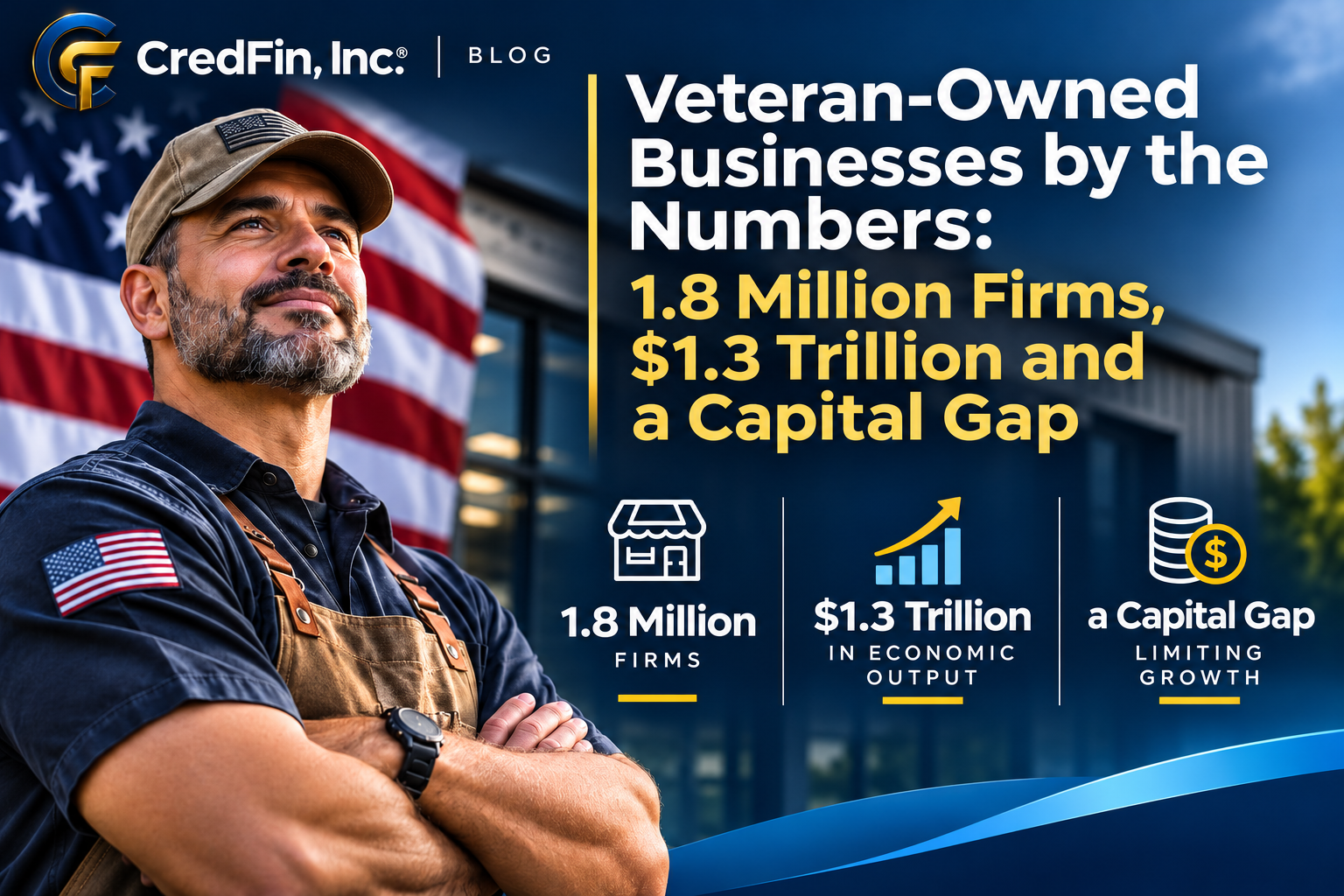
Veteran-Owned Businesses by the Numbers: 1.8 Million Firms, $1.3 Trillion and a Capital Gap
Veterans make up about 4% of American workers and own about 5% of American businesses. This Veterans Day week, we looked at what the latest federal data says about those businesses: how many there are, what they contribute, and where they still run into trouble getting capital.
The big picture
The SBA Office of Advocacy's 2026 veteran ownership report, built on 2023 Census Bureau data, counts every business where veterans own half or more:
Measure | Veteran-owned businesses |
|---|---|
Businesses | 1,816,591 |
Jobs supported | 4,479,861 |
Annual revenue | Nearly $1.3 trillion |
Share of all U.S. businesses | 5.1% |
Veterans' share of U.S. workers | 4.2% |
Share of businesses with employees | 6.3% |
Veterans own a larger share of businesses than their share of the workforce would predict. The difference is widest among businesses with employees, the ones that create jobs.
Veterans are also strongly represented in manufacturing. They own 43,446 manufacturers, 7.1% of the sector, with $144.3 billion in revenue.
A closer look at employer firms
The Census Bureau uses a stricter definition: businesses that are majority veteran-owned and have paid employees. Its latest Annual Business Survey counts about 261,000 of them in 2023, or 4.4% of the 5.9 million U.S. employer firms.
The prior year's survey gives the fuller financial picture for 2022:
Measure (2022) | Majority veteran-owned employer firms |
|---|---|
Firms | 273,542 |
Receipts | $884.5 billion |
Employees | 3.2 million |
Annual payroll | $179.7 billion |
The count fell by about 12,500 firms from 2022 to 2023. One year doesn't make a trend, but it fits a longer pattern. A Federal Reserve and SBA study found that self-employment among veterans in the labor force dropped from 16% in 1998 to 11% in 2018. Earlier SBA reports also found that veteran owners skew older than other owners, which means many of these businesses face a succession or sale in the coming years.
Federal contracting is a real advantage
Federal contracting is the one area where the system is built to favor veteran-owned firms. Congress raised the government-wide goal for contracts to service-disabled veteran-owned small businesses (SDVOSBs) from 3% to 5%, and agencies have met it three years running, according to the Congressional Research Service:
Fiscal year | Prime contract dollars to SDVOSBs | Share of eligible dollars |
|---|---|---|
2019 | $21.8 billion | 4.34% |
2021 | $25.0 billion | 4.41% |
2023 | $31.9 billion | 5.07% |
2025 | $32.5 billion | 5.01% |
That is roughly 49% more contract dollars in six years. Subcontracting has not kept pace: SDVOSBs received 2.42% of subcontract dollars in fiscal 2025, short of the goal.
To compete for these set-asides, a business must be certified through the SBA's Veteran Small Business Certification program, often called VetCert. Self-certification ended in 2024. The core requirements:
Veterans must own and control at least 51% of the business. For SDVOSB status, that 51% must be held by veterans the VA has rated as service-disabled.
The business must qualify as small under SBA size standards.
Certification must be renewed every three years.
The capital gap
Financing is where veteran-owned firms report more difficulty than their peers. Federal Reserve research has found the same pattern across several years:
Finding | Veteran-owned firms | Other firms | Source |
|---|---|---|---|
Said credit availability was a financial challenge | 32% | 25% | |
Owner used personal savings to fund the business | 72% | 62% | Fed Small Business Credit Survey, 2022 |
Received less financing than they asked for | 60% | 52% | |
Rated as low credit risk | 61% | 69% | Fed and SBA study, 2018 |
The same research points to a few reasons:
Thinner credit histories. Frequent moves during military service make it harder to build the long, stable credit record lenders like to see.
Smaller requests. In the 2018 study, 60% of veteran applicants sought $100,000 or less. Small loans cost lenders about as much to process as large ones, so some lenders are less interested.
Higher-cost lenders. In the 2022 survey, 32% of veteran-owned firms applied to online lenders, compared with 18% that applied to small banks. Online-lender applicants reported lower satisfaction.
Late help. SBA officials told the researchers that many veteran entrepreneurs look for guidance only after an application has already failed.
What veteran owners can do before applying
The data suggests the preparation matters as much as the application. Four steps address the gaps above:
Check all three business credit files. Dun & Bradstreet, Experian Business and Equifax Business each keep their own record. Look for missing or outdated information before a lender does.
Line up your business information. Your legal name, address and phone number should match across your state filing, EIN letter, bank account and website.
Organize your financials. Have recent statements and a clear plan for how you would use and repay the money. This matters most for smaller requests, where lenders spend less time on each file.
Get certified if you sell to government. If federal agencies or their contractors buy what you sell, VetCert certification lets you compete for veteran set-asides. Agencies awarded SDVOSBs more than $30 billion in prime contracts in each of the last three fiscal years.
The SBA's Office of Veterans Business Development is the agency's starting point for veteran-specific programs.
Where CredFin fits
Most businesses have no one whose job is to get the company ready for capital. That is the role CredFin plays as a business funding department. Our Capital Qualified™ program combines ApprovalReady™, which helps you understand and strengthen your business credit profile across all three bureaus, with CashFlowReady™, which helps you organize your financials and plan how financing would be used and repaid.
If you're a veteran business owner planning your next stage of growth, see your potential financing options or book a free 30-minute Funding Strategy Session. There's no cost and no obligation.
To the veterans who served and then built businesses that employ millions of Americans: thank you.
CredFin, Inc. is a business credit coaching and funding advisory company, not a lender, and is not affiliated with the SBA, the VA or any government agency. Financing decisions are made by independent third-party providers, and funding is not guaranteed. Figures come from the public sources linked above and use different definitions and years, as noted. This article is general education, not legal, tax or financial advice.
Find Out What Lenders See Before You Apply
Book a free 30-minute Funding Strategy Session. We'll review your business credit across all three bureaus and show you exactly what to fix first.